
Understanding Maker & Taker Fees
Learn the difference between Maker and Taker fees on PLUBIT Exchange. This guide explains how trading fees work, when each fee applies, and how understanding Maker and Taker orders can help you trade more efficiently.
By plubit support · August 5, 2026
Every trade on PLUBIT Exchange involves a trading fee. Depending on how your order is executed, you may be charged either a Maker Fee or a Taker Fee.
Understanding the difference between these two fee types can help you better manage your trading costs and choose the most appropriate order type for your trading strategy.
In this guide, you'll learn what Maker and Taker fees are, how they work, and when each fee applies.
What Are Trading Fees?
Trading fees are small charges applied when you buy or sell cryptocurrency on PLUBIT Exchange.
These fees help support the exchange's trading infrastructure and liquidity.
The exact fee rate depends on your account level and the type of order you place.
You can always check the latest trading fee schedule on the PLUBIT Fee page.
What Is a Maker?
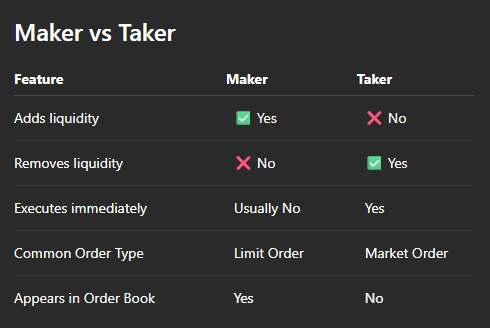
A Maker is a trader who adds liquidity to the market.
This happens when you place an order that is not executed immediately and instead remains in the Order Book waiting for another trader to match it.
The most common example is a Limit Order.
Example
Bitcoin is currently trading at 100,000 USDT.
Instead of buying immediately, you place a Buy Limit Order at 98,000 USDT.
Your order waits in the Order Book until the market reaches your selected price.
Because your order adds liquidity to the market, you are considered a Maker.
What Is a Taker?
A Taker is a trader who removes liquidity from the market.
This occurs when your order is executed immediately against existing orders in the Order Book.
Market Orders are the most common example of Taker orders.
Example
Bitcoin is trading at 100,000 USDT.
You submit a Market Buy Order.
PLUBIT immediately matches your order with the lowest available sell orders.
Because you removed liquidity from the Order Book, you are considered a Taker.
How Trading Fees Are Applied
When your order is completed, PLUBIT automatically calculates the applicable trading fee.
The fee is based on:
- Your account's trading fee tier.
- Whether your order acted as a Maker or Taker.
- The value of the completed trade.
Trading fees are deducted automatically during settlement.
Why Are Maker Fees Sometimes Lower?
Many cryptocurrency exchanges encourage traders to provide liquidity.
Orders that remain in the Order Book improve market efficiency by making it easier for other users to trade.
For this reason, Maker fees are often lower than Taker fees.
However, actual fee rates may vary depending on PLUBIT's current fee schedule.
Which Order Types Are Maker or Taker?
Generally:
Market Order
- Usually acts as a Taker because it executes immediately.
Limit Order
- Usually acts as a Maker if it remains in the Order Book.
However, if a Limit Order matches an existing order immediately after submission, it may instead be treated as a Taker.
How to Reduce Trading Fees
You can potentially reduce your trading costs by:
- Using Limit Orders when appropriate.
- Avoiding unnecessary trades.
- Reviewing current trading fees before placing orders.
- Monitoring your trading activity.
- Understanding how your orders interact with the Order Book.
Tips for Beginners
If you're just starting:
- Learn the difference between Market Orders and Limit Orders.
- Don't focus only on trading fees—consider execution speed and market conditions as well.
- Review your completed trades to understand which fee type was applied.
- Choose the order type that best fits your trading objective.
Frequently Asked Questions (FAQ)
1. What is the difference between a Maker and a Taker?
A Maker adds liquidity by placing orders that remain in the Order Book.
A Taker removes liquidity by executing against existing orders immediately.
2. Does every trade have a fee?
Yes.
Trading fees apply whenever a trade is successfully executed.
3. Are Maker fees always lower?
Not necessarily.
Fee rates depend on PLUBIT's current fee schedule and your account level.
4. Is every Limit Order a Maker Order?
No.
If a Limit Order executes immediately against an existing order, it may be treated as a Taker Order.
5. Where can I see the trading fees charged?
You can review completed trades and applicable fees in your Trade History and refer to the official PLUBIT fee schedule for current rates.
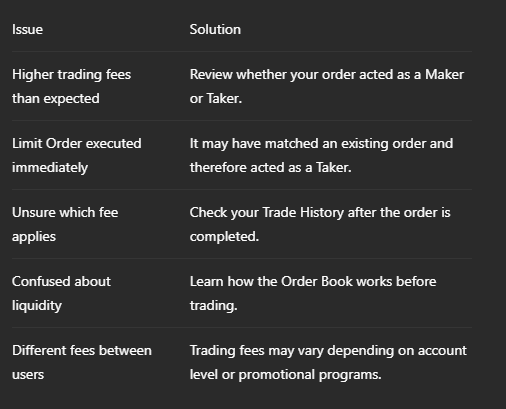
Common Issues
Final Thoughts
Understanding Maker and Taker fees is an important part of becoming a more informed cryptocurrency trader. Knowing how your order interacts with the Order Book can help you better understand execution speed, market liquidity, and trading costs.
Rather than focusing only on fees, choose the order type that best supports your trading strategy and objectives.